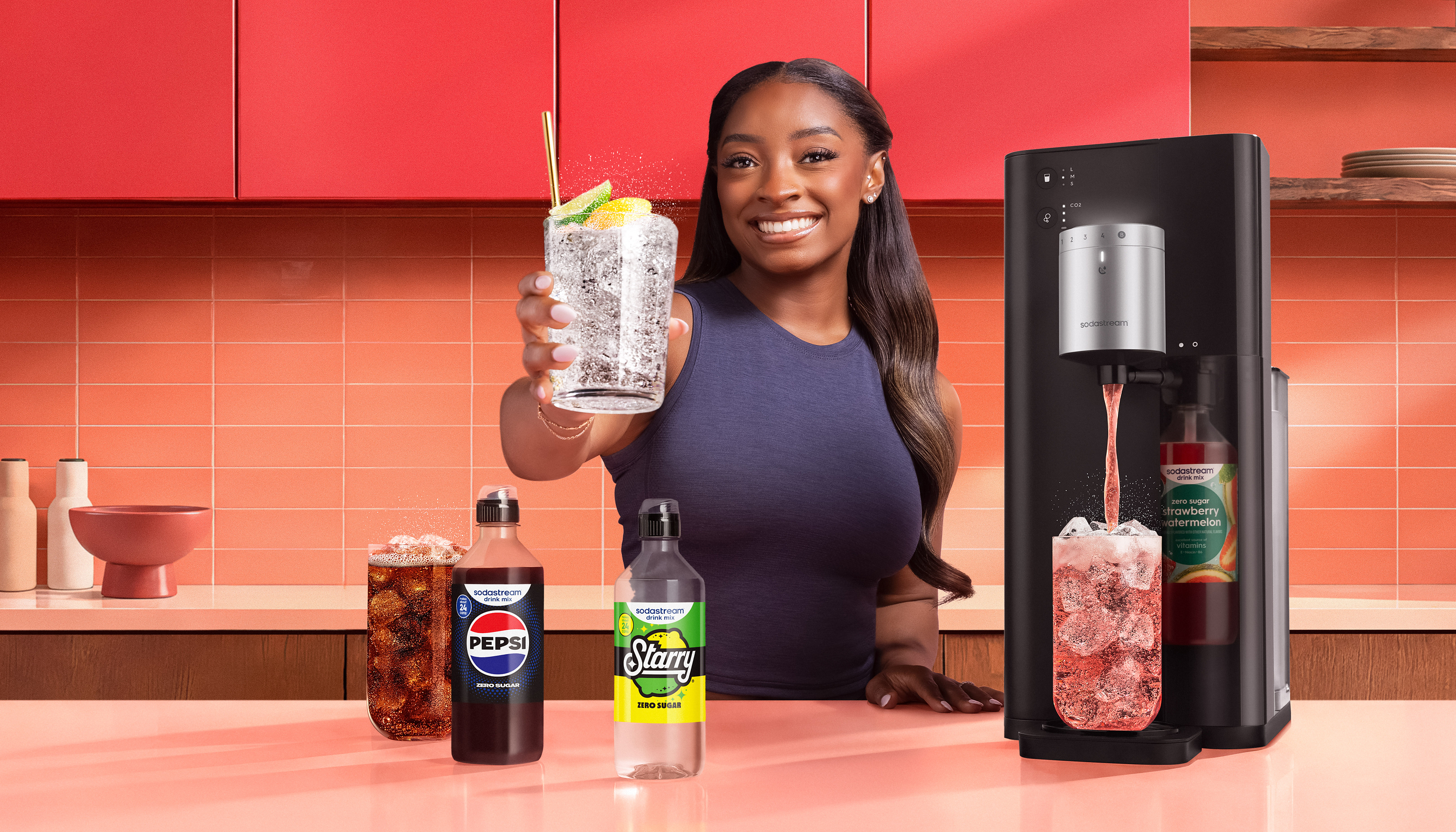
PepsiCo subsidiary SodaStream is pushing beyond its sparkling-water-maker roots with the Fountain, a $199.99 countertop beverage system that delivers adjustable carbonation, variable flavor intensity, and three serving sizes — 8, 16, and 24 ounces — in a single unit. The hardware, available now through Walmart, Target, Amazon, and direct-to-consumer at sodastream.com, draws on a flavor library of more than 40 SKUs spanning PepsiCo house brands including Pepsi, Mountain Dew, Starry, bubly, and Mug. The company estimates the system unlocks approximately 1,000 drink combinations, a figure based on internal calculations of available settings and flavor availability by market.
Retail & Route-to-Market
Distribution at launch is entirely off-premise and DTC, with no on-premise placement announced. The mass-retail sweep — Walmart, Target, and Amazon — gives the Fountain immediate national shelf presence without the complexity of a wholesale or three-tier route. SodaStream's CO₂ cylinder exchange network, already embedded in many of those same retail chains, provides a built-in consumables replenishment loop that drives repeat traffic and recurring revenue well beyond the hardware transaction. The launch-day promotion — 20% off sitewide at sodastream.com using code LAUNCH20, excluding CO₂ — is structured as a one-time, single-use offer, signaling the brand's intent to protect cylinder margin while stimulating hardware trial.
Flavor Portfolio & Competitive Context
The Fountain's flavor deck is where PepsiCo's vertical integration becomes commercially significant. Licensing its own trademark brands — Pepsi, Mountain Dew, Starry, bubly, Mug — into the SodaStream ecosystem sidesteps third-party flavor supplier negotiations and locks the consumables supply chain inside the parent company. For retailers, the 40-plus-SKU flavor assortment creates a planogram opportunity in the home-beverage aisle that competes directly with single-serve pod systems and canned sparkling-water sets. The broader non-alc sparkling-water and flavored-water segment has sustained strong volume growth as consumers shift spend from single-use packaged beverages, a tailwind SodaStream has ridden since PepsiCo acquired the brand. The Fountain represents an upsell into a higher hardware price point and a more complex consumables basket than the brand's legacy sparkling-water-maker line.
To lead the launch campaign, SodaStream signed gymnast Simone Biles as brand ambassador, deploying her across TV, digital, in-store, and social channels including Instagram and TikTok. Aliza Leferink, Chief Marketing Officer at SodaStream North America, framed the partnership around the brand's pivot from commodity carbonation hardware to a customization-forward beverage platform. The celebrity ambassador strategy is aimed squarely at driving consumer pull-through at retail — a critical lever when a $199.99 price point requires more than end-cap placement to convert. For beverage operators and non-alc category buyers tracking at-home consumption trends, the Fountain's launch signals that the intersection of personalization and sustainability — reusable systems versus single-use packaging — is becoming a primary battleground for volume in the non-alc sparkling segment. Retailers and wholesalers supplying home-beverage hardware and consumables should expect SodaStream to press the Fountain aggressively into planograms as holiday sets are built for Q4 2026.
Written by Michael Politz, Author of Guide to Restaurant Success: The Proven Process for Starting Any Restaurant Business From Scratch to Success (ISBN: 978-1-119-66896-1), Founder of Food & Beverage Magazine, the leading online magazine and resource in the industry. Designer of the Bluetooth logo and recognized in Entrepreneur Magazine's "Top 40 Under 40" for founding American Wholesale Floral, Politz is also the Co-founder of the Proof Awards and the CPG Awards and a partner in numerous consumer brands across the food and beverage sector.